Introduction
I’m a machine-learning researcher specialising in computer vision, with a focus on applications in neutrino physics. I began my journey in 2018 and carried out my PhD research at CERN. Since 2021, I’ve been a member of the Rubbia group at ETH Zurich.
My work primarily involves event reconstruction in neutrino experiments. I have contributed to
DUNE in the United States and am currently involved in
T2K and
Hyper-K in Japan, as well as
FASER at CERN. Within T2K, I serve as the convener for machine-learning activities for the near detector. I have presented my research at international conferences and published in respected journals, particularly on applying deep learning to neutrino analysis.
I also teach AI applications in neutrino physics and have previous teaching experience in Computer Architecture, Operating System Design, and Distributed Systems.
Experience
-
Senior scientist
ETH Zürich, Zurich, Switzerland (Feb 2021 — present) -
Doctoral student
CERN, Geneva, Switzerland (Feb 2018 — Jan 2021) -
Visiting student
University of Cambridge, Cambridge, United Kingdom (Mar 2019 — Apr 2019) -
CERN openlab summer student
CERN, Geneva, Switzerland (Jul 2017 — Sep 2017) -
Research and teaching assistant
Universidad Carlos III de Madrid, Madrid, Spain (Jul 2015 — Jan 2018)
Selected publications
-
"An ultrafast plenoptic-camera system for high-resolution 3D particle tracking in unsegmented scintillators" Till Dieminger, , Christoph Alt, Claudio Bruschini, Noemi Bührer, Edoardo Charbon, Kodai Kaneyasu, Tim Weber, Davide Sgalaberna, Nature Communications, 2026.Link
-
"Towards foundation-style models for energy-frontier heterogeneous neutrino detectors via self-supervised pre-training" , Fabio Cufino, Umut Kose, Anna Mascellani, André Rubbia, arXiv pre-print, 2026.Link
-
"Submanifold sparse convolutional networks for automated 3D segmentation of kidneys and kidney tumours in computed tomography" , Leigh H. Whitehead, Adam Aurisano, Lorena Escudero Sanchez, Scientific Reports, 2026.Link
-
"Deep-learning-based low-energy trigger algorithms for the Hyper-Kamiokande experiment" Katharina Lachner, , Benjamin Richards, Davide Sgalaberna, arXiv pre-print, 2026.Link
-
"Transformer-Based Pulse Shape Discrimination in HPGe Detectors with Masked Autoencoder Pre-training" Marta Babicz, , Alain Fauquex, Laura Baudis, Machine Learning Science and Technology, 2026.Link
-
"Contrastive learning for robust representations of neutrino data" Alex Wilkinson, Radi Radev, , Physical Review D, 2025.Link
-
"AI-based particle track identification in scintillating fibres read out with imaging sensors" Noemi Bührer, , Matthew Franks, Till Dieminger, Davide Sgalaberna, Journal of Instrumentation, 2025.Link
-
"Deep-learning-based decomposition of overlapping-sparse images: application at the vertex of simulated neutrino interactions" , Davide Sgalaberna, Xingyu Zhao, Adrien Molines, Clark McGrew, André Rubbia, Communications Physics, 2024.Link
-
"Artificial intelligence for improved fitting of trajectories of elementary particles in dense materials immersed in a magnetic field" , Davide Sgalaberna, Xingyu Zhao, Clark McGrew, André Rubbia, Communications Physics, 2023.Link
-
"Adversarial methods to reduce simulation bias in neutrino interaction event filtering at liquid argon time projection chambers" Marta Babicz, , Stephen Dolan, Kazuhiro Terao, Physical Review D, 2022.Link
-
"Graph neural network for 3D classification of ambiguities and optical crosstalk in scintillator-based neutrino detectors" , Dana Douqa, César Jesús-Valls, Thorsten Lux, Sebastian Pina-Otey, Federico Sánchez, Davide Sgalaberna, Leigh H. Whitehead, Physical Review D, 2021.Link
-
"Neutrino interaction classification with a convolutional neural network in the DUNE far detector" B. Abi et al. (DUNE Collaboration), Physical Review D, 2020.Link
-
"Image-Based Model Parameter Optimization Using Model-Assisted Generative Adversarial Networks" , Leigh H. Whitehead, IEEE Transactions on Neural Networks and Learning Systems, 2020.Link
-
"Convolution on neural networks for high-frequency trend prediction of cryptocurrency exchange rates using technical indicators" , Andrés Suárez-Cetrulo, Alejandro Cervantes, David Quintana, Expert Systems with Applications, 2020.Link
For a comprehensive list of publications, please refer to the following profiles.


Invited talks
-
"From pixels to particles: deep learning in accelerator neutrino experiments" ( CAMBRIDGE, UNITED STATES) Plenary talk, 2026 IAIFI Summer Workshop, MIT, Aug 10-14, 2026.Link
-
"Deep learning for neutrino physics" ( LONDON, UNITED KINGDOM) Plenary talk, NuPhys 2026: Prospects in Neutrino Physics, King's College London, January 7-9, 2026.Link
-
"Algorithmic View on Deep Learning for Accelerator Neutrino Experiments" ( ZURICH, SWITZERLAND) Plenary talk, ZPW2026: Machine Learning Techniques for Particle Physics, University of Zurich, January 5-7, 2026.Link
-
"Pushing the boundaries of neutrino physics with deep learning" ( MENLO PARK, UNITED STATES) Seminar, SLAC National Accelerator Laboratory, Stanford University, May 8, 2025.Link
-
"Machine learning methods for event reconstruction in accelerator neutrino experiments" ( L’ÉPINE, FRANCE) Conference talk, 5th World Summit on Exploring the Dark Side of the Universe (EDSU2024), Île de Noirmoutier, Jun 2-7, 2024.Link
-
"Artificial intelligence and machine learning in neutrino physics" ( PROCIDA, ITALY) Conference talk, 22nd International Workshop on Next Generation Nucleon Decay and Neutrino Detectors (NNN23), Procida, Oct 11-13, 2023.Link
-
"Computer vision introduction" ( MENLO PARK, UNITED STATES) Lecture, SLAC Summer Institute, SLAC National Accelerator Laboratory, Stanford University, Aug 7-18, 2023.Link
-
"Machine learning for neutrino experiments" ( KASHIWA, JAPAN) Seminar, Kavli Institute for the Physics and Mathematics of the Universe (IPMU), University of Tokyo, Jul 6, 2023.Link
-
"Machine learning and high-performance computing for neutrino oscillations" ( NICOSIA, CYPRUS) Seminar, EuroHPC National Competence Centre, The Cyprus Institute, Oct 18, 2022.Link
-
"Deep learning in neutrino experiments" ( ZURICH, SWITZERLAND) Colloquium, Institute for Particle Physics and Astrophysics, ETH Zurich, Nov 3, 2020.Link
-
"Machine learning in neutrino experiments" ( SHEFFIELD, UNITED KINGDOM) Seminar, Department of Particle Physics and Particle Astrophysics, University of Sheffield, Nov 18, 2019.Link
-
"Machine learning in neutrino experiments" ( STONY BROOK, UNITED STATES) Seminar, Department of Physics and Astronomy, Stony Brook University, Oct 28, 2019.Link
-
"Machine learning for neutrino identification" ( MEXICO CITY, MEXICO) Plenary conference talk, Symposium on Artificial Intelligence for Science, Industry and Society, UNAM, Oct. 21-25, 2019.Link
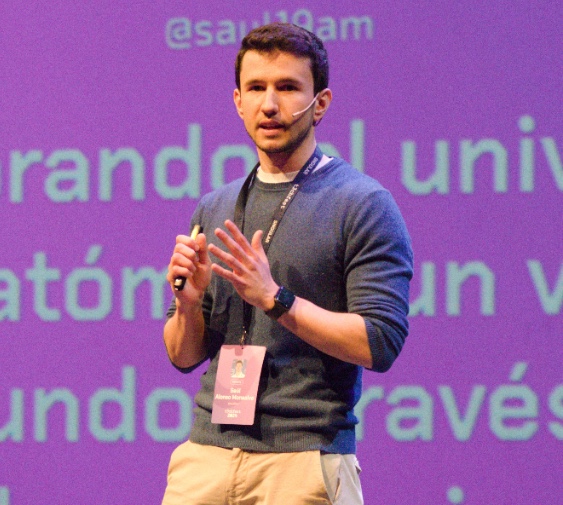
Public outreach talk at T3chFest (in Spanish)
Events organised
Highlighted awards and grants
-
ETH Zurich Spark Award (Top-5 finalist) ETH Zurich: Top-5 finalist for the invention "A sharper eye for PET scanners", 2026.Link
-
Swiss AI Initiative grant (Principal investigator) Swiss AI: 50,000 GPU compute-node hours for the project "Scalable and Transferable AI for Neutrino Physics", 2026.Link
-
AI for Science (AI4Sci@NERSC) grant (Principal investigator) NERSC (Lawrence Berkeley National Laboratory, CA, USA): 5,000 GPU compute-node hours for the project "Deep Learning for Neutrino Event Reconstruction", 2025–2026.Link
-
Swiss AI Initiative grant (Principal investigator) Swiss AI: 30,000 GPU compute-node hours for the project "Artificial Intelligence for Neutrino Physics", 2025.Link
-
HDR ML Challenge National Science Foundation: 3rd place among 275 participants (2,478 submissions) in the Anomaly Detection Challenge on LIGO O3 gravitational-wave data (nsfhdr.org/mlchallenge), 2025.Link
-
Enrique Fuentes Quintana award Funcas Organization, for the best Spanish doctoral thesis within the fields of Engineering, Mathematics, Physics and Architecture, Dec 2022.Link
-
Spanish Computer Science Society (SCIE) award BBVA Foundation, for young computer science researchers, for the distinguishing, innovative, and relevant doctoral work, Nov 2022.Link
-
Margarita Salas award Madrid City Council, accessit for one of the best doctoral theses in the field of basic sciences, Nov 2022.Link
-
Outstanding thesis award Universidad Carlos III de Madrid: for the unique merits and values of the doctoral thesis, 2021.Link
-
Excellence award Social Council, Universidad Carlos III de Madrid, Former students (Alumni): for the excellent professional development carried out between 3 and 5 years after graduation, 2021.Link
-
National parallel programming competition Sociedad Arquitectura y Tecnología de Computadores, Jornadas Sarteco (programming tasks using OpenMP, MPI, and CUDA), 2nd place (Málaga 2017), 3rd place (Salamanca 2016).Link
-
Programming competition T3chFest UC3M, 1st place (algorithmics using Python), Madrid, Feb 2016.Link
Contact
- Email salonso "at" ethz.ch / saul.alonso.monsalve "at" cern.ch
- Office HPK F 30 (Hönggerberg campus), Otto-Stern-Weg 5, 8093 Zürich, Switzerland.
- Profiles
-
Featured in
-
EL PAÍS
-
Cadena SER
-
XLSemanal
-
ETH Zurich Partnerships
-
ETH Zurich Physics
-

